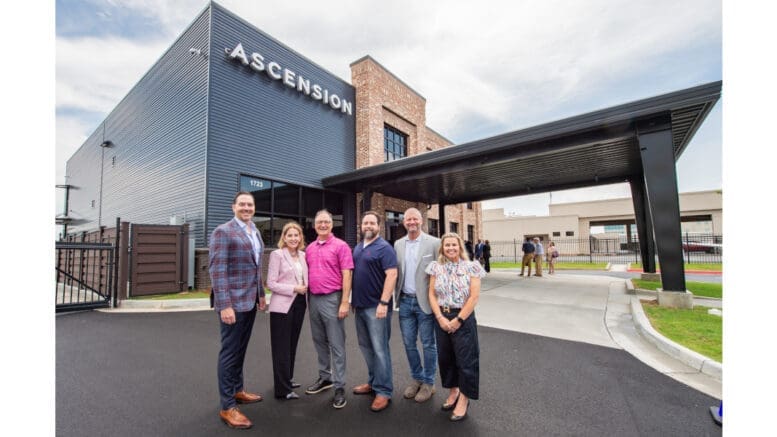
PHOTO ABOVE (L-R) Joe Hansen, Executive Vice President of Business Development, Ascension, Leslie McIntyre, Chief Human Resources Officer, Ascension, Grant Rainwater – Senior Project Manager, CROFT & Associates, Chris Philhower – Project Manager of CROFT & Associates, Steven Hudgins, President, Rainwater Construction,Stacey Chapman – Senior Vice President of CROFT & Associates
Kennesaw-based CROFT & Associates announced in a press release that community leaders, aviation partners and project stakeholders gathered to celebrate the ribbon cutting of the new Ascension fixed-base operator (FBO) terminal at Cobb County International Airport – McCollum Field.
CROFT wrote that the project was designed to enhance the airport’s role as a gateway for business aviation and economic development in metro Atlanta.
The new terminal, designed by CROFT & Associates and delivered through a design-build partnership with Rainwater Construction, provides a modern arrival experience for pilots, passengers, business travelers and international visitors. The facility also strengthens the airport’s position as one of metro Atlanta’s busiest aviation hubs.
Officials attending the ribbon-cutting ceremony included representatives from Ascension, the Cobb County Airport Authority Board, Cobb County Government, Cobb County Chairwoman Lisa Cupid, members of the Cobb County Board of Commissioners, the Cobb Chamber, Cobb Select, Town Center CID, and members of the design and construction teams.
“This project represents what can happen when a community rallies around a shared vision,” said Stacey Chapman, Senior Vice President of Strategy at CROFT & Associates. “The new terminal is more than a building. It is a front door to Cobb County and an investment in the future of business, aviation, and economic development in our community.”
The project began in Commissioner JoAnn Birrell’s district and when completed it was within Commissioner Keli Gambrill’s district.
Rainwater Construction served as the project’s design-builder, while CROFT provided architecture and engineering services. Construction took place adjacent to active airport operations, requiring coordination among the airport, owner, design team and contractor to maintain uninterrupted airport activity while meeting strict operational and safety requirements.
The terminal was designed to combine operational efficiency with a hospitality-focused experience. Architectural detailing, premium interior finishes, specialty ceiling systems and integrated exterior materials were incorporated to create a welcoming environment for travelers arriving in Cobb County.
“Business aviation is often someone’s first impression of a community,” said Chris Philhower, Project Manager for CROFT. “We wanted this facility to feel professional, welcoming, and reflective of the quality and energy that define Cobb County.”
The new terminal complements the airport’s existing infrastructure, which includes more than 500,000 square feet of hangar space, 50 acres of ramp area, the longest runway in metro Atlanta and the region’s only dedicated U.S. Customs facility.
CROFT wrote that for its firm, which is headquartered near the airport, the project represents an opportunity to contribute to the community it calls home.
“As a Cobb-based firm, it’s incredibly rewarding to help create a facility that will welcome visitors, businesses, and travelers to our community for years to come,” Chapman said. “This project required the commitment of many partners, and the ribbon cutting was a celebration of that collective effort.”
About Cobb International Airport-McCollum Field
The Cobb County International Airport – McCollum Field is a public-use general aviation airport located about 20 miles northwest of downtown Atlanta. Owned and operated by the Cobb County Department of Transportation, the airport serves as a major hub for corporate and private aviation rather than commercial airline service. Since opening in 1960, it has grown into one of Georgia’s busiest general aviation airports, supporting more than 300 based aircraft, dozens of aviation-related businesses, and more than 110,000 flight operations each year.
Beyond aviation, the airport is an important economic asset for Cobb County and the metro Atlanta region. It generates an estimated $129 million in annual economic impact, supports approximately 1,000 jobs, and serves as an international gateway for business travelers, having welcomed flights from dozens of countries in recent years. Its facilities include a 6,295-foot runway, extensive hangar and ramp space, air traffic control services, and a full range of aviation support services, including aircraft maintenance, charter operations, flight training, and ground handling.