
A Heat Advisory remains in effect across much of north and central Georgia until 8 p.m. Saturday, with heat index values reaching as high as 107 degrees. The National Weather Service warns that the combination of hot temperatures and high humidity could cause heat illnesses.
The National Weather Service issued a heat advisory for north and central Georgia for Saturday, Sep. 5, 2026.
Weather reports can be packed with unfamiliar terms. Our plain-English guide to understanding weather reports explains what they mean—and what you should pay attention to.
What is in the Hazardous Weather Outlook?
The hazardous weather outlook states the following:
339 AM EDT Sat Sep 5 2026
…HEAT ADVISORY REMAINS IN EFFECT UNTIL 8 PM EDT THIS EVENING…
- WHAT…Heat index values up to 107.
- WHERE…Portions of central, east central, north central,
northeast, northwest, southeast, and west central Georgia.- WHEN…Until 8 PM EDT this evening.
- IMPACTS…Hot temperatures and high humidity may cause heat
illnesses.PRECAUTIONARY/PREPAREDNESS ACTIONS…
Drink plenty of fluids, stay in an air-conditioned room, stay out of
the sun, and check up on relatives and neighbors. Young children and
pets should never be left unattended in vehicles under any
circumstances.Take extra precautions if you work or spend time outside. When
possible, reschedule strenuous activities to early morning or
evening. Know the signs and symptoms of heat exhaustion and heat
stroke.To reduce risk during outdoor work, the Occupational Safety and
Health Administration recommends scheduling frequent rest breaks in
shaded or air conditioned environments. Anyone overcome by heat
should be moved to a cool and shaded location. Heat stroke is an
emergency! Call 9 1 1.
Counties included in the alert
- Baldwin
- Banks
- Barrow
- Bartow
- Bibb
- Bleckley
- Butts
- Carroll
- Catoosa
- Chattahoochee
- Chattooga
- Cherokee
- Clarke
- Clayton
- Cobb
- Coweta
- Crawford
- Crisp
- Dade
- DeKalb
- Dodge
- Dooly
- Douglas
- Emanuel
- Fayette
- Floyd
- Forsyth
- Glascock
- Gordon
- Greene
- Gwinnett
- Hall
- Hancock
- Haralson
- Harris
- Heard
- Henry
- Houston
- Jackson
- Jasper
- Jefferson
- Johnson
- Jones
- Lamar
- Laurens
- Macon
- Madison
- Marion
- Meriwether
- Monroe
- Montgomery
- Morgan
- Murray
- Muscogee
- Newton
- North Fulton
- Oconee
- Oglethorpe
- Paulding
- Peach
- Pickens
- Pike
- Polk
- Pulaski
- Putnam
- Rockdale
- Schley
- South Fulton
- Spalding
- Stewart
- Sumter
- Talbot
- Taliaferro
- Taylor
- Telfair
- Toombs
- Treutlen
- Troup
- Twiggs
- Upson
- Walker
- Walton
- Warren
- Washington
- Webster
- Wheeler
- Whitfield
- Wilcox
- Wilkinson
What is the heat index?
The NWS defines the heat index as follows on its website:
The heat index, also known as the apparent temperature, is what the temperature feels like to the human body when relative humidity is combined with the air temperature. This has important considerations for the human body’s comfort. When the body gets too hot, it begins to perspire or sweat to cool itself off.
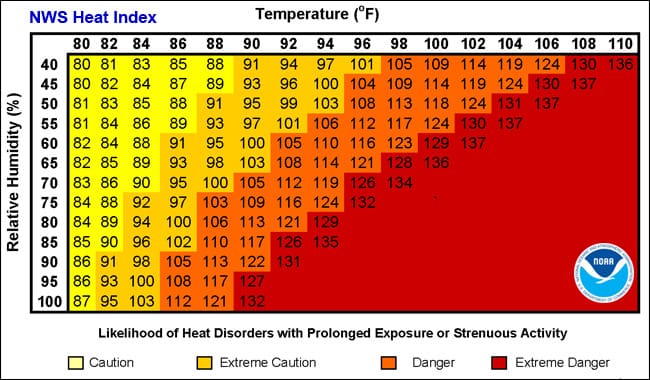
Chart from NOAA showing relationship between relative humidity and temperature in heat index
About the National Weather Service
The National Weather Service (NWS) is a federal agency within the National Oceanic and Atmospheric Administration (NOAA), part of the U.S. Department of Commerce. Its primary mission is to provide weather, water, and climate data, forecasts, and warnings to protect life and property and to enhance the national economy.
Headquartered in Silver Spring, Maryland, the NWS operates through a network of six regional headquarters and more than 100 local Weather Forecast Offices (WFOs) across the country. These offices issue weather forecasts, warnings, advisories, and watches tailored to specific geographic areas.
Metro Atlanta is served by the National Weather Service’s Atlanta/Peachtree City Weather Forecast Office, located in Peachtree City. The office issues forecasts, watches, warnings and other weather information for much of north and central Georgia, including Cobb County.
The NWS also runs specialized centers, including the Storm Prediction Center (SPC) for severe weather outlooks, the National Hurricane Center (NHC) for tropical storm tracking, the Weather Prediction Center (WPC) for national forecast guidance, and the Space Weather Prediction Center (SWPC) for solar activity that may affect Earth-based systems.
NWS forecasts and alerts are based on data from a combination of satellites, radar systems, weather balloons, surface observation stations, and computer models. The agency collaborates with emergency managers, broadcasters, government agencies, and the public to ensure that timely and accurate information is disseminated during weather events.
Its services are made available to the public at no cost, and its warnings—such as tornado warnings, flash flood alerts, and winter storm advisories—serve as official guidance for public safety and emergency response.
Editor’s note: AI was used in the production of this article. To read about when and why we made use of AI, read our article “How, When and Why the Cobb County Courier uses AI.”