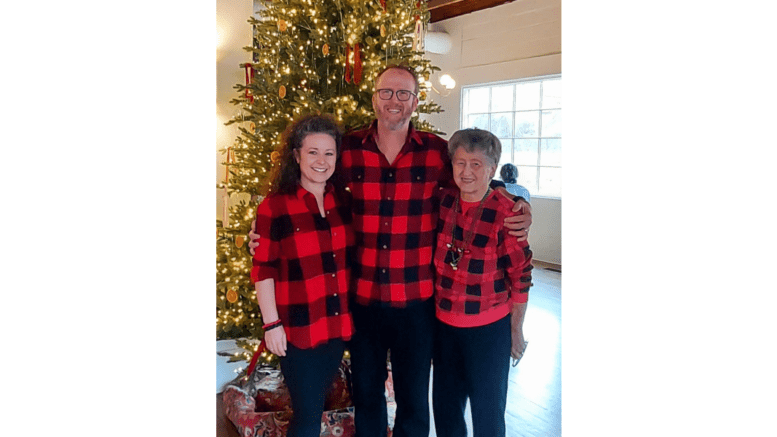
Photo above: Brian Benefield, his wife Cecilie, and mom, Yvonne
[This is the latest installment of “Cobb Cuisine, Culture and Community” by Brian Benefield. Photo above by Brian Benefield]
As Christmas approaches each year, the familiar hum of commercialism grows louder. Store windows sparkle, advertisements insist, and wish lists multiply like ornaments on an overburdened tree. Yet in the middle of all that noise, there is a quieter feeling that has taken root in me: I do not want anything for Christmas. This is not a rejection of the holiday, but a rejection of the idea that joy must be purchased and wrapped.
Although I don’t ask for gifts, our small family decided many years ago to give only consumable or experience gifts to each other. Rather than receive a microwaveable pasta maker (why), or provide an absurd tie that no one would wear, I’d rather spend time with people that matter to me. I enjoy cooking for others, and there’s no better expression of love than preparing a thoughtful meal for someone special.
Not wanting anything for Christmas feels like stepping out of a rushing crowd and standing still. Commercialism tells us that love is measured in receipts and that price tags prove generosity. It suggests that meaning can be delivered in two-day shipping. But the older I get, the more hollow that promise feels. The thrill of opening something new fades quickly, leaving behind clutter and the faint pressure to want more next year. Choosing not to want anything becomes an act of clarity, a way to remember what Christmas was meant to hold.
At its heart, Christmas is about presence, not presents. It is about showing up at tables, in conversations, and in each other’s lives. When I say I want nothing, I am really saying I want time. Time to sit without rushing, to listen without distraction, to laugh without checking the clock. These moments cannot be bought or returned, and they do not lose their value once the packaging is gone.
Commercialism thrives on comparison, quietly asking us to measure our celebrations against someone else’s. Bigger trees, better gifts, more impressive displays. Not wanting anything for Christmas frees me from that scoreboard. It allows the holiday to be small if it needs to be, simple if it wants to be. A modest meal, familiar stories, and shared silence can feel more sacred than any elaborate exchange. In choosing simplicity, I reclaim the holiday from expectations that never truly belonged to me.
There is also a sense of gratitude woven into this refusal. To want nothing is to recognize that I already have enough. Warmth, food, safety, and people who care about me. These simple things are not guaranteed, yet they are often overlooked in the shadow of novelty. When I stop focusing on what I might receive, I become more aware of what I already hold. Gratitude becomes the gift I both give and receive.
Not wanting anything for Christmas does not mean rejecting generosity. It means redefining it. A handwritten note from a friend, a shared walk with my wife and my dog, Pickles, or a thoughtful act carries more weight than something purchased out of obligation. Giving becomes intentional rather than performative. It becomes an expression of care rather than compliance with tradition.
In a season saturated with buying, choosing to want nothing is quietly radical. It is a declaration that my worth is not seasonal and my joy is not for sale. By stepping away from commercialism, I make space for something older and truer: a Christmas shaped not by consumption, but by connection, reflection, and peace.
What a beautiful reminder and a great article.
Perfectly crafted message! I completely agree! Merry Christmas.