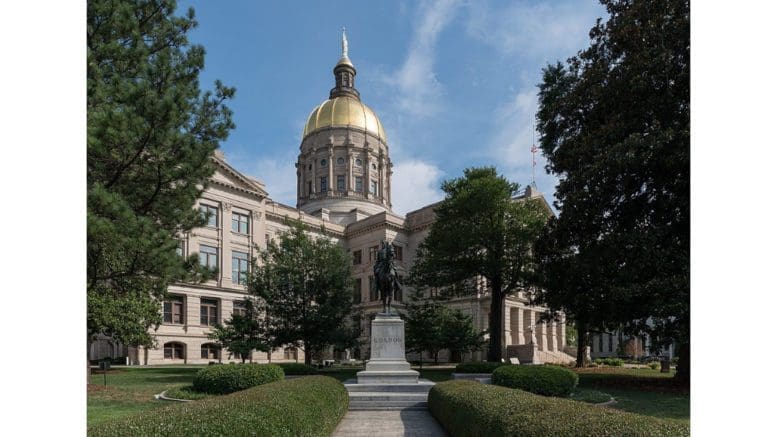
by Alander Rocha, Georgia Recorder, [This article first appeared in the Georgia Recorder, republished with permission]
January 7, 2026
Georgia GOP Senate leaders unveiled a plan Wednesday that would entirely eliminate the personal state income tax by 2032, shortly before House Speaker Jon Burns said the House would focus on cutting property taxes.
A special Senate committee voted 6-3, along party lines, to adopt its final legislative recommendations, which would waive income taxes for all Georgians on up to $50,000 a year for individuals and $100,000 for married couples starting in 2027.
Sen. Blake Tillery, the Vidalia Republican who chaired the committee, said the proposal is a “bottom-up” approach aimed at addressing rising costs for struggling Georgians. He pitched it as a solution to recent concerns about affordability, which Democrats successfully campaigned on in the 2025 off-year elections.
“The issue of affordability has been a buzzword since probably June or July,” said Tillery, who is also the Senate’s top budget writer. “This is the first vote that we are going to get to take to address affordability. I would urge you to think about that and think about how you can continue to say that that’s the number one issue, if you don’t support addressing it for Georgia families here.”
The plan would cost the state about $3 billion in the first year. To pay for it, Tillery pointed to nearly $1.9 billion surplus from the previous budget year as well as $1 billion in savings from a move to finance capital projects rather than using cash, and he said the rest could come from trimming roughly 10% of the state’s $30 billion in special-interest tax credits. The proposal is a priority for Lt. Gov. Burt Jones, who formed the committee and is running for governor in 2026. Tillery is a candidate for lieutenant governor.
In a press conference later on Wednesday, Burns, a Newington Republican, also acknowledged that affordability is a top issue going into the 2026 session. But he said the House will prioritize cutting property taxes on primary residences, saying that some Georgians have seen property tax increases of up to 185% over the previous year.
“That’s grossly unfair to Georgia homeowners, and probably just as importantly, maybe not quite as important, but it’s not sustainable,” Burns said.
But both Tillery and Burns said they would be open to considering each other’s proposals, with Tillery saying that he does “not view this as an either-or with the House.”
“The revenues go to completely different places, and the plan that we’ve drawn out with our state revenues to make this work are in no way impacted by anything they bring on property taxes,” Tillery said.
Burns said that “there’s nothing [the House and the Senate] can’t talk about,” but he was more critical of the Senate proposal, saying the math does not add up.
“We have to have the details, and it has to work, and we need to make sure we can continue to provide those services: health care, public safety, education, all the things we’ve talked about that continue to make Georgia the very best place to live and work,” Burns said.
Democrats on the Senate committee pushed back on the income tax cut proposal, saying that it would create a “$16 billion hole” in the state budget while ignoring critical needs in mental health, education and rural health care.
“This report recommends capping the budget and continuing to have our hands behind our back in terms of meeting the needs that we have,” said Atlanta Democratic Sen. Nan Orrock, adding that the state should instead focus on helping rural counties “that are so bereft of medical services,” increasing access to mental health services or fully funding pre-K for all Georgians.
Orrock also said that there is too much uncertainty around how Georgia will adapt to incoming federal funding cuts, which will reduce the state’s federal Medicaid funding by an estimated $5.4 billion over the next decade, according to a recent Georgia Health Initiative report.
“We heard no information in the course of this committee’s hearings on the impact of the cuts in Washington that are coming down that will hit our budget … We’re going to have needs that can be documented — should have been documented,” Orrock said.
Orrock also said that once fully implemented, the income tax cut would largely benefit people earning over $100,000, with $11.5 billion in tax cuts for the top 26% of income earners, compared to the $4 billion tax cut to the other three-quarters of Georgians.
“Is that what the citizenry is calling for? Helping the rich get richer? I don’t think so,” Orrock said after the meeting.
Danny Kanso, a senior fiscal analyst at the Georgia Budget and Policy Institute, also said that the proposal would largely benefit the wealthy. In a statement, he said that 74% of all benefits would go to households earning six-figures or more per year, adding that “this proposal would dramatically push Georgia’s budget out of balance in order to enrich those already at the top of the economic ladder, while working and middle-class families ultimately foot the bill.”
Without finding a new source of revenue to replace the $16 billion in personal income tax currently collected, most Georgians could see overall state taxes increase once the program is fully implemented, according to GBPI.
“The committee’s lack of specific recommendations to replace Georgia’s largest revenue source speaks volumes and points towards the most likely outcome: increasing Georgia’s sales tax and raising the cost of living,” Kanso said. “While most Georgians would see an average net tax increase of about $1,000 per year if the state shifts to a sales tax-based revenue system, those in the top 1% (earning more than $835,000 per year) would see average tax cuts of about $60,000 per year.”
Democratic Sen. Ed Harbison of Columbus called the proposed deductions “a hard thing to vote against,” but said the committee should be more fiscally conservative with the timeline. Instead of “taking one giant step and doing it all in one fell swoop,” Harbison suggested the committee should instead consider a more gradual income tax decrease.
“I hear your very logical and conservative budgeting, and I applaud you for that. We have been doing that, and I thought that we would continue down that road,” he said.
Georgia Recorder is part of States Newsroom, a nonprofit news network supported by grants and a coalition of donors as a 501c(3) public charity. Georgia Recorder maintains editorial independence. Contact Editor Jill Nolin for questions: info@georgiarecorder.com.