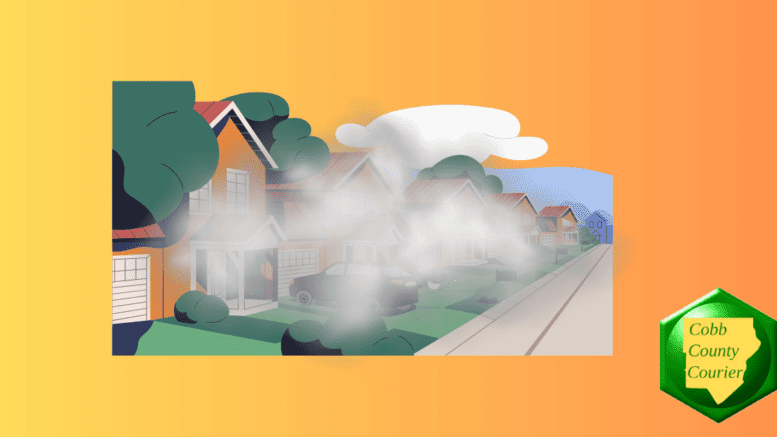
North and central Georgia face dense fog through Monday morning and a risk of strong thunderstorms later today, with forecasters warning that some storms could bring damaging winds, frequent lightning, small hail, and locally heavy rainfall as unsettled weather continues into midweek.
The National Weather Service issued a hazardous weather outlook for north and central Georgia for Monday, March 9, 2026.
Bonus for the more weather-curious among you … To read an article about interpreting a weather news report with some of the typical terminology defined, follow this link.
What is in the statement?
The statement gives the following details:
This Hazardous Weather Outlook is for north and central Georgia.
.DAY ONE…Today and Tonight…
Areas of fog are likely tonight into Monday morning. Some fog
will be dense, with visibility as low as one quarter mile. A Dense
Fog Advisory is in effect across much of north and central
Georgia until 11 AM Monday.
A line of thunderstorms is expected late this afternoon across
western Georgia. Isolated portions of this line could produce
damaging winds, frequent lightning and small hail.
.DAYS TWO THROUGH SEVEN…Tuesday through Sunday…
Thunderstorms may become more widespread Wednesday into Thursday.
Isolated strong to severe storms with damaging wind gusts,
frequent lightning, and locally heavy rainfall will be possible.
What counties are affected?
The following counties are included in the hazardous weather outlook:
- Baldwin
- Banks
- Barrow
- Bartow
- Bibb
- Bleckley
- Butts
- Carroll
- Catoosa
- Chattahoochee
- Chattooga
- Cherokee
- Clarke
- Clayton
- Cobb
- Coweta
- Crawford
- Crisp
- Dade
- Dawson
- DeKalb
- Dodge
- Dooly
- Douglas
- Emanuel
- Fannin
- Fayette
- Floyd
- Forsyth
- Gilmer
- Glascock
- Gordon
- Greene
- Gwinnett
- Hall
- Hancock
- Haralson
- Harris
- Heard
- Henry
- Houston
- Jackson
- Jasper
- Jefferson
- Johnson
- Jones
- Lamar
- Laurens
- Lumpkin
- Macon
- Madison
- Marion
- Meriwether
- Monroe
- Montgomery
- Morgan
- Murray
- Muscogee
- Newton
- North Fulton
- Oconee
- Oglethorpe
- Paulding
- Peach
- Pickens
- Pike
- Polk
- Pulaski
- Putnam
- Rockdale
- Schley
- South Fulton
- Spalding
- Stewart
- Sumter
- Talbot
- Taliaferro
- Taylor
- Telfair
- Toombs
- Towns
- Treutlen
- Troup
- Twiggs
- Union
- Upson
- Walker
- Walton
- Warren
- Washington
- Webster
- Wheeler
- White
- Whitfield
- Wilcox
- Wilkes
- Wilkinson
What is meant by “isolated” and “scattered”?
The NWS defines “isolated” as follows:
A National Weather Service convective precipitation descriptor for a 10 percent chance of measurable precipitation (0.01 inch). Isolated is used interchangeably with few.
“Scattered” has the following definition:
When used to describe precipitation (for example: “scattered showers”) – Area coverage of convective weather affecting 30 percent to 50 percent of a forecast zone(s).
Isolated thunderstorms and scattered thunderstorms are two terms used to describe different distributions of thunderstorm activity within a particular area. The main difference lies in the extent of coverage and how the thunderstorms are spatially distributed:
Isolated Thunderstorms:
Isolated thunderstorms are relatively rare occurrences that happen sporadically and are generally confined to a limited area.
These thunderstorms are often characterized by being few and far between, with significant gaps between individual storm cells.
Typically, isolated thunderstorms cover less than 20% of the forecast area.
Despite their isolated nature, these storms can still be intense and may produce heavy rain, lightning, gusty winds, and possibly hail.
Scattered Thunderstorms:
Scattered thunderstorms are more widespread than isolated thunderstorms and cover a larger portion of the forecast area.
In a scattered thunderstorm scenario, numerous individual thunderstorms develop, but they are not continuous or widespread enough to be classified as a “line” or “cluster” of storms.
Scattered thunderstorms generally cover between 30% to 50% of the forecast area.
Although scattered thunderstorms are more widespread, they still leave considerable gaps between storm cells, and not everyone within the forecast area will necessarily experience a thunderstorm.
In summary, isolated thunderstorms are fewer in number and more localized, covering a smaller area with significant gaps between storms, while scattered thunderstorms are more widespread, covering a larger area with numerous individual storms occurring somewhat randomly across the forecast area.
About the National Weather Service
The National Weather Service (NWS) is a part of the National Oceanic and Atmospheric Administration (NOAA).
The National Weather Service (NWS) provides weather, water, and climate forecasts and warnings for the United States, its territories, adjacent waters and ocean areas, for the protection of life and property and the enhancement of the national economy.
These services include Forecasts and Observations, Warnings, Impact-based Decision Support Services, and Education in an effort to build a Weather-Ready Nation. The ultimate goal is to have a society that is prepared for and responds to weather, water and climate events.